Advent Week 4, day 1
Candle of Love

Dear ones, today we lit the fourth candle of Advent. The candle of Love.
This candle burns closest to Christmas. The waiting has narrowed. The question before us is no longer abstract. Love is not discussed at a distance. Love is chosen. Love is enacted. Love steps forward.
Advent love is not measured by intention or feeling. It is known by response. By consent. By the quiet courage to do what is asked, even when our first words fall short.
Dear ones, this morning was shaped by the beauty of the Eucharist. Bread broken. Wine shared. A gathered body focused not on itself, but on the Lord. There is a particular stillness that comes when the table holds our attention, and Christ becomes our center. It is never loud. It is never rushed. And yet it fills the whole space.
There were small, beautiful things woven through the day. Familiar faces. Shared prayer. The steady grace of being together in worship. And then, unexpectedly, a surprise visit from a new friend. Not planned. Not anticipated. Simply given. That presence added more joy than i could have arranged on my own.
Love often arrives this way. Quietly. Through shared devotion. Through simple gifts. Through people we did not expect, but needed.
Scripture
The Parable of the Two Sons
Matthew 21:28–32
Jesus said,
What do you think? A man had two sons. He went to the first and said, Son, go and work in the vineyard today. He answered, i will not. But later he changed his mind and went.
The father went to the second and said the same. And he answered, I go, sir. But he did not go.
Which of the two did the will of his father?
They said, The first.
Jesus said to them, Truly I tell you, the tax collectors and the prostitutes are going into the kingdom of God ahead of you. For John came to you in the way of righteousness, and you did not believe him, but the tax collectors and the prostitutes believed him. And even after you saw it, you did not change your minds and believe him.
This is the Gospel of the Lord,
Praise to You, Lord Christ.
Psalm
Psalm 80:16–18
Let Your hand be upon the one at Your right hand,
the one You have made so strong for Yourself.
And so will we never turn away from You.
Give us life, that we may call upon Your Name.
Reflection
Dear ones, this parable unsettles us because it refuses to flatter our intentions. Love is not proven by the right answer. It is proven by the changed direction.
One son says no, then goes.
The other says yes, then stays.
Advent love lives in the turning.
God is less interested in polished responses than in transformed lives. Repentance here is not shame. It is movement. It is the willingness to reconsider, to turn again, to step into the work even after resistance has been spoken.
This is the love that comes to us in Christ.
God does not wait for perfect obedience before drawing near. God enters the world knowing hesitation, knowing fear, knowing the complexity of human hearts. And still, God comes.
The love candle reminds us that saying yes once is not the same as living yes daily. Love matures through action. Through showing up. Through choosing the vineyard again and again.
Sometimes love begins with refusal. With fear. With honest resistance. What matters is not the first word spoken, but the life that follows.
Advent asks whether i am willing to change my mind.
Whether i am willing to let love redirect me.
Whether my yes is still becoming real.
Closing Prayer
God of patient love,
You meet us even when our words falter.
Teach us to turn again toward Your will.
Give us courage to step into the work You place before us,
not perfectly, but faithfully.
Let our love be known by what we do.
Amen.
Blessing
May love guide your steps.
May Christ meet you in the turning.
And may your yes grow stronger
as Christmas draws near.
Go in peace, dear ones.
Art Reflection
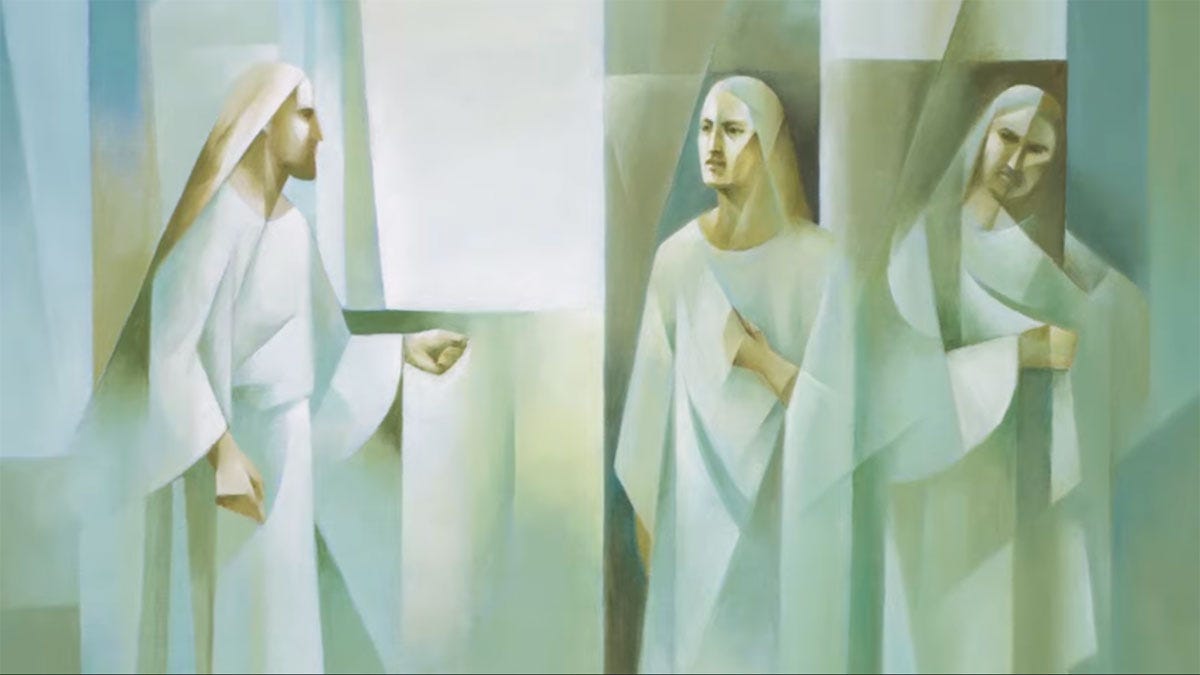
The Two Sons
Jorge Cocco Santángelo
Sacrocubist style
This painting does not shout. It waits.
Jorge Cocco Santángelo’s sacrocubist vision fractures the scene just enough to slow us down. Planes of light and shadow overlap. Figures are elongated, softened, almost translucent. Nothing is rigid. Everything is becoming.
The father stands steady, extending an invitation rather than a command. His gesture is calm. Open. Patient. Love does not force itself here. It asks.
The two sons appear similar at first glance, yet their inner posture is different. One leans inward, guarded. The other turns away, uncertain. Cocco does not dramatize the contrast. He lets it remain quiet, unresolved. Just like the parable.
This is important. The parable of the Two Sons is not about villains and heroes. It is about movement. About the distance between words and lives. About how love is revealed not in what is promised, but in what is done.
The fractured geometry serves the theology. Repentance is not a clean line. Obedience is not immediate. Love often requires a turning, a reorientation, a slow alignment of the heart with the will of God. Cocco paints that tension rather than resolving it.
Notice how light does not come from a single source. It seems to pass through the figures themselves. This is Advent light. Love working from the inside out. Love illuminating after the fact. Love revealed in the going, not the speaking.
This painting belongs in the final days of Advent because it refuses certainty. It asks a sharper question. Not which son sounds faithful, but which one walks into the vineyard. Not who speaks well, but who moves.
The love candle burns beside this image with honesty. Love is not proven by eloquence. Love is proven by obedience that takes shape over time. Sometimes love begins with resistance. Sometimes faith arrives late. God receives both when they turn toward Him.
The painting leaves us standing in that space. Between word and deed. Between refusal and repentance. Between promise and practice.
Advent does not demand perfection.
It asks for movement.
It asks for turning.
It asks whether love has legs.
And quietly, patiently, God waits for our answer.